Showing posts with label phones. Show all posts

Thursday, September 4, 2014

, , ,

IFA 2014: Sony Xperia Z3, Z3 Compact and Z3 Tablet Compact announced

Sony has just taken the wraps off its next flagship device, the Xperia Z3 and joining it is the Xperia Z3 Compact and Xperia Z3 Tablet compact. Let us take a look at what each of the device is offering:

Sony Xperia Z3

Sony Xperia Z3
The new flagship comes in just 6 months after the launch of the Xperia Z2. It comes with a slight upgrade under the hood over the last generation in the form of a 2.5 GHz quad core Snapdragon 801 processor, a 3GB RAM and an Adreno 330 GPU. It gets the same screen as the last one which is a 5.2 inch full HD unit. It sheds off 11 grams of weight over the last generation and loses 1mm of thickness as well.
It makes use of Sony DSEE HX audio technology for an enhanced audio experience and its build quality surely makes you look twice at it.

Sony Xperia Z3 Specifications

  • 5.2-inch Triluminos display with Live Colour LED and a resolution of 1920 x 1080 pixels. It is powered by the X-Reality engine.
  • 2.5 GHz quad core Qualcomm Snapdragon 801 processor, Adreno 330 GPU, 3GB RAM
  • Android 4.4.4 KitKat
  • 16GB of internal storage which can be expanded further by 128GB
  • 20.7MP rear camera with Exmos RS sensor and a 2.2MP front facing camera. The rear camera supports 4K video recording while the front one supports full HD video recording.
  • IP65/IP68 certified for water and dust proofing
  • It tips the scales at 152 grams and its thickness stands at 7.3mm
  • 4G LTE /3G HSPA+, Wi-Fi, Bluetooth 4.0, GPS with GLONASS, MHL 3.0 and NFC
  • Black, white, green and copper colours
  • 3100 mAh Battery with STAMINA mode which allows for usage for a longer duration

Sony Xperia Z3 Compact
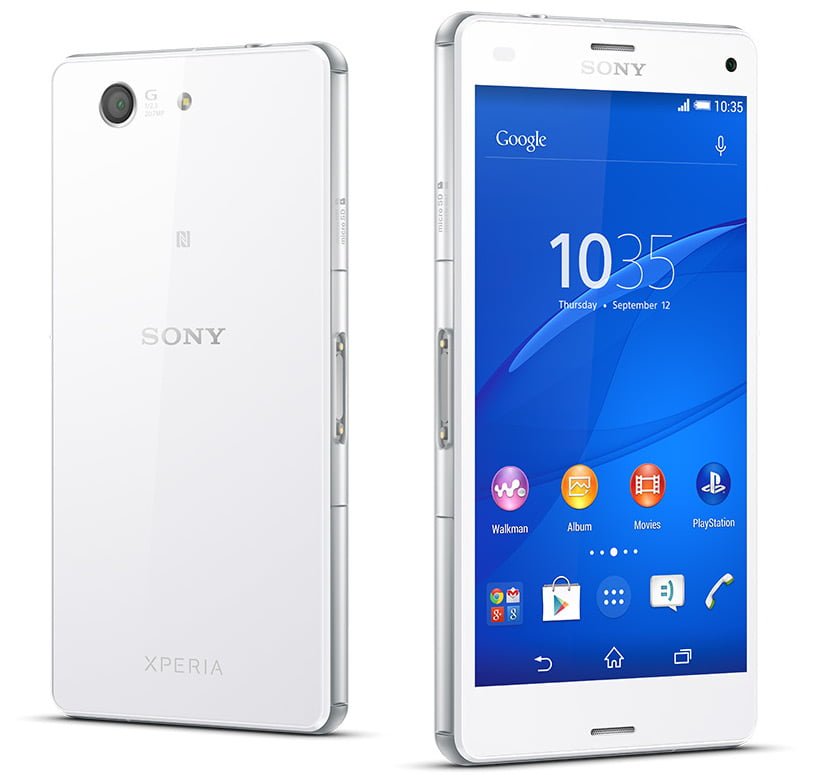
Xperia Z3 Compact
Xperia Z3 Compact
The successor to the Xperia Z1 compact packs in quite a punch for a device of its size. It gets a 4.6 inch 720p display which is an up from the 4.3 inch unit of the Xperia Z1 and gets a bigger battery too (2,600 mAh from 2,300 mAh). Sony has tried to keep the essence of making it a mini version of the flagship by carrying over almost everything in the hardware department.

Sony Xperia Z3 Compact Specifications

  • 4.6 inch Triluminos display with a resolution of 1280 x 720 pixels with the X-Reality engine powering it.
  • 2.5 GHz quad core Qualcomm Snapdragon 801 processor
  • Adreno 330 GPU
  • 2GB RAM
  • Android 4.4.4 KitKat
  • 16GB of internal storage which can be expanded further by 128GB
  • 20.7MP rear camera with Exmos RS sensor and a 2.2MP front facing camera. The rear camera supports 4K video recording while the front one supports full HD video recording.
  • IP 65/68 certified for water and dust proofing
  • Its thickness stands at 8.9mm and weighs 129 grams
  • 4G LTE /3G HSPA+, Wi-Fi, Bluetooth 4.0, GPS with GLONASS, MHL 3.0 and NFC take charge of connectvity
  • Black, white, green and orange colours
  • 2600 mAh Battery with STAMINA mode

Xperia Z3 Tablet Compact
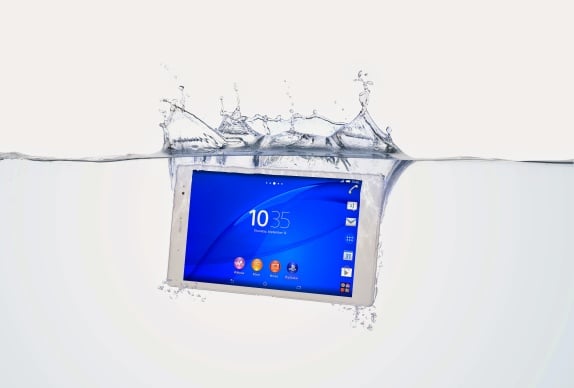
Sony Xperia Z3 Tablet Compact
Sony likes to call its the “slimmest and lightest waterproof tablet” and it is basically a Sony Xperia Z3 packed into a tablet. It will be one of the better tablets when it goes on sale. The tablet will pose quite a lot of threat to the likes of the Nexus 9 and the next generation of iPad Mini. It has an 8 inch display with Contrast Enhancement. It comes with a matte rear finish and ditches the glass panels of the Xperia Z3 for it.

Sony Xperia Z3 Tablet Compact Specifications

  • 8-inch display, 1920 x 1200 pixels
  • Android 4.4.4 KitKat
  • 2.5GHz quad-core Qualcomm Snapdragon 801 processor, Adreno 330 GPU, 2GB RAM
  • 16GB of internal storage which can be expanded further by 128GB
  • 8.1MP rear camera and 2.1MP front camera
  • IP 65/68 certified for water and dust proofing
  • Its thickness stands at 6.4mm and weighs 270 grams. This weighs pretty less when compared to many and slim waistline makes it really easy to hold it.
  • Black and white colours
  • 4500 mAh Battery which provides upto 13 hours of video playback
The three devices will be launched in October globally and their pricing will be one of the key factors determining their success.

Saturday, March 15, 2014

, , , ,

Did you know how phones track your location using Wi-Fi?

There's a GPS radio built into most modern smartphones. It is what the device uses to pin-point its own location, aided by a bunch of satellites that float above us, of course. This, however, isn't the only technique used to track the whereabouts of handsets and their users. Crowd-sourced Wi-Fi data also helps in the process. This is why if your phone's Wi-Fi is turned off, your mapping or navigation app might ask you to enable it for better accuracy.


But how does Wi-Fi know where we are anyway? Isn't its purpose to get us hooked to the internet? Well, while the latter is true, Wi-Fi can also be used to obtain a mobile device's position. That is possible thanks to the set of location services built into today's popular operating systems, namely Android, iOS, and Windows Phone. When enabled, these services scan the area for Wi-Fi networks and log their locations in a huge database. This database is shared across devices, which allows a smartphone or tablet to get its approximate location by knowing what Wi-Fi networks are around it. 


Location pin-pointing using Wi-Fi data is less accurate than GPS, but it could improve location accuracy in cases when satellite signal isn't excellent or totally missing

View the Original article

, , , ,

Ubuntu phones to sell for $200 to $400, is this the right strategy?

Canonical's founder Mark Shuttleworth is one person in the tech world who it seems always has something interesting to say, and today he was at the CeBIT computer expo in Germany, where he definitely had a few good words about the plans for Ubuntu Touch. Shuttleworth talked about the potential price points, and the intended user base, but we have to wonder if the strategy is sound.
Shuttleworth and company have never been shy about aiming high with Ubuntu Touch. The team has always been clear that it wants to see Ubuntu Touch running on high-end hardware, even though it would be usable on lower-end hardware. We all saw the spectacular failure that was the Ubuntu Edge, which could have been any smartphone enthusiast's dream, but unfortunately it couldn't generate the funding needed to make it a reality (though, it should be noted that the fundraising certainly proved the market for such a device, which is likely an argument that Canonical has used when speaking to potential hardware partners.)
At CeBIT today, Shuttleworth also said that Canonical is not aiming to convert iPhone users, who more often have an "emotional attachment to the Apple ecosystem", but rather will be aiming at Android users. Shuttleworth says that non-Apple systems don't tend to have the same "emotional attachment", but there is also a need in that space for a platform that is easy to use, which he says is not something that you would find with Android. In the end, Shuttleworth clarified the target market for Ubuntu, saying that handsets will be selling in the "mid-higher edge, so $200 to $400". The reasoning for this maybe a bit more telling though, as Shuttleworth went on to say:
We're going with the higher end because we want people who are looking for a very sharp, beautiful experience and because our ambition is to be selling the future PC, the future personal computing engine.
This is very interesting, because it points to the marketing strategy for Ubuntu, but it is a somewhat controversial strategy. Consider these two points: 
The high-end smartphone market is becoming saturated, meaning the growth potential is in the low-end. The PC market is shrinking.
We've seen it in plenty of areas and with quite a few manufacturers: aiming at the high-end doesn't really work with smartphones. HTC nearly ran itself out of business by abandoning the mid and low-end markets before deciding this year to re-enter those spaces. Windows Phone has been showing great growth numbers over the past year, but almost all of that movement comes in the low-end market. Even Samsung relies heavily on a myriad of low-end smartphones released around the world in order to maintain the revenue that it has in the mobile sphere. Only Apple has been successful in the smartphone market without a true low-end option (aside from re-releasing three and a half year old hardware for emerging markets, which doesn't really count given its price tag.) 
But, that's the trick with Ubuntu. Canonical isn't really aiming at the smartphone market, it seems. As Shuttleworth said, Canonical wants "to be selling the future PC". This of course brings us to the second point, which is that the PC market isn't really any better than focusing on the high-end smartphone market, and it could be even worse in the end. PC sales are down almost across the board (once again, Apple is the outlier). The general thinking is that mobile devices like smartphones and tablets are eating away at the PC market, but that doesn't mean that mobile devices are necessarily replacing traditional PCs. However, that is exactly what Canonical wants to do with Ubuntu. 
A convergent opportunity? 
While many users have found that tablets are good enough for the majority of computing uses (checking e-mail, browsing the web, consuming content, and some light gaming), there are also some users who still need a traditional PC for a variety of uses (mostly more advanced things like photo/video editing, or more hardcore gaming). The first group greatly outnumbers the second, but the second group is far more outspoken (as you will see in most Internet message boards and comment threads). The question is whether Ubuntu will be able to fill the needs of both groups, because while the more tech advanced may be the minority, they hold a lot of power because they are often giving advice or flat out making the decisions for the more casual computing group. 
Software
This is important for a couple of reasons. First, Ubuntu is a Linux system, which still has the reputation for being less user friendly than options like Windows or Mac/iOS. Android has been by far the most successful Linux-based system, but Android doesn't yet have a presence on traditional PCs (though that is supposedly on the way). Casual users will need fears of switching to be soothed in order for Ubuntu to see more mass adoption. A big part of this will be in software, and by that we don't necessarily mean the OS software, but rather the apps and games available. 
Unfortunately, this has traditionally been a weak point for Linux distributions. While Linux has always offered a substantial selection of quality apps, it doesn't have the brands that people are used to seeing. There is no Microsoft Office, no Photoshop, and no iTunes. Instead, you'll find OpenOffice, GIMP, and Rythmbox or Banshee. This shouldn't necessarily be that big a deal, but it usually is. It was the same issue that Android faced in its early days, and the issue that Windows Phone is currently facing - the apps are there and they are good quality, but they are off-brand. 


View the Original article

Sunday, December 29, 2013

, , , , , ,

Microsoft connects Windows 8 for PCs, phones with new Solitaire, Minesweeper and Mahjong

As a late holiday gift, Microsoft is finally syncing up some of the popular software from its desktop and tablet Windows OS with the latest version of Windows for phones. We are, of course, referring to classic Windows games like Microsoft Solitaire Collection, Minesweeper (which also has a WP7 version) and Mahjong, which as of today are available on Windows Phone 8. Better still, they're enhanced for Xbox leaderboards, achievements and stat-tracking, with the ability to pause and resume games across Windows PCs, phones and tablets. They're all free, so hit the links to download them and waste time on the go just like you do at work.


View the Original article

Saturday, December 21, 2013

, , , , , ,

BLU unveils two budget Android phones with 3G on more North American carriers

BLU Products' unlocked smartphones have only been truly useful in North America when using bigger carriers like AT&T and Rogers, but the company is giving us a few more choices today. Its new Advance 4.0 and Studio 5.0 II both support HSPA

View the Original article

Wednesday, December 18, 2013

, , , , , ,

Huawei's Honor brand challenges Xiaomi with 3X and 3C low-cost phones

Huawei's known for its Ascend smartphones around the world, but back in late 2011, the company also started toying with a small Honor series for select budget markets. Fast forward to today, the latter sub-brand has become Huawei's platform to compete with the sudden surge of affordable online brands in China -- most notably Xiaomi, the pioneer of that industry. With a little help from MediaTek (and ironically not Huawei's own HiSilicon), the phone maker is upping its firepower over this territory with two new dual-SIM devices: Honor 3X and Honor 3C.

The Honor 3X joins the first wave of octa-core 1.7GHz MT6592-powered devices, and it boasts 2GB of RAM, a 13-megapixel f/2.2 main camera, a 5-megapixel 1.4-micron front imager plus a generous 3,000mAh battery. The 720p resolution on the glove-friendly, 5.5-inch IPS touchscreen may seem like a let-down, but in this case, Huawei reasoned that going 1080p would push power consumption up by as much as 20 percent, plus many folks may not notice the visual difference -- a point that Huawei Device Chairman Richard Yu has often echoed publicly.

On a brighter note, the 3X is the first phone to feature dual-3G SIM slots -- one Mini SIM and one Micro SIM -- for WCDMA (China Unicom and most carriers around the world) and TD-SCDMA (China Mobile). Better yet, both slots will recognize either type of 3G radio, as opposed to having designated slots for each. There's also a dual-mic system for in-call noise cancellation, as well as DTS audio support. The price? From just CN¥1,698 or about $280 off-contract, making it a tad more affordable than the Xiaomi MI3. Alas, there's no launch date just yet.


View the Original article